

Stress in global private credit markets and its implications for euro area financial stability
Prepared by Katharina Cera, Daniel Dieckelmann, Kalin Nikolov, Glenn Schepens and Oscar Schwartz Blicke[1]
Recent stress in parts of the US private credit market − including concerns about exposures in the software sector and redemption pressure in semi-liquid vehicles − has led to renewed focus on possible financial stability risks stemming from private credit and the potential relevance of such risks for the euro area. This special feature looks at the exposure of the euro area financial system to private credit. Using available commercial, public and proprietary data, it finds that euro area financial institutions appear to have limited direct exposure to private credit. This makes it unlikely that private credit in isolation could be a source of systemic financial instability at present. However, insurance corporations and pension funds in particular could, in an adverse scenario, face more material second-round revaluation losses from broader spillovers to leveraged loans, high-yield bonds and equities. Private credit could promote long-term growth by channelling funds from long-term investors to innovative firms, thereby supporting the objectives of the EU’s savings and investments union. The market should nonetheless be monitored closely, especially in view of worsening credit quality, possible expansion into retail-oriented structures and a potential role of private credit in AI-related financing. Reducing private credit’s opacity, addressing data gaps and working towards a harmonised definition of private credit at a global level would avoid a potential underestimation of direct exposures and enable risk to be assessed more completely.
1 Current concerns in private credit markets
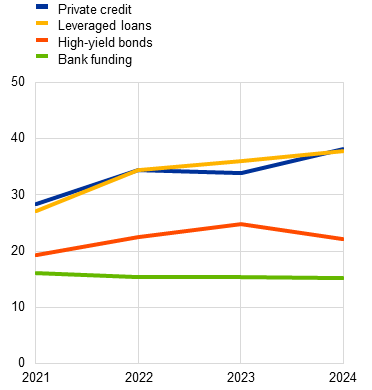
Private credit markets have come under scrutiny from investors and policymakers over concerns about credit quality and concentrated exposures to the software sector. Since autumn 2025, several defaults linked to private credit markets – including First Brands, an auto parts manufacturer, and Tricolor, a subprime auto lender − have illustrated how weak underwriting standards and opacity can transmit losses across parts of the financial industry. While these incidents may partly involve fraud, they have drawn attention to the ease with which firms can accumulate excessive leverage in this opaque industry. In addition, the ability of private credit-backed firms in the euro area to service interest payments from operating cash flows has deteriorated in recent years. This trend can also be observed among firms funded through broader leveraged loan and high-yield bond markets, while it is absent for firms relying on bank loans. (Chart D.1, panel a). Furthermore, investors have recently become concerned about the substantial exposure of private credit to the software sector, the biggest subsector of the IT industry (Chart D.1, panel b). This is because substantial improvements in the capabilities of AI models have triggered concerns that the technology could disrupt the business models of some software firms. These developments are particularly illustrative of the interactions between credit risk and market risk. They are relevant for the euro area not because direct domestic exposures are large, but because euro area investors, borrowers and asset managers are linked to global private credit markets.
Chart D.1
Credit quality in euro area private credit markets has deteriorated, and a high proportion of global private credit deals involves IT companies
a) Share of euro area firms with interest coverage ratios below 1 |
b) Share of key sectors in global private credit deals |
|---|---|
(2018-24, percentages) |
(2020-26; percentages, € trillions) |
 |
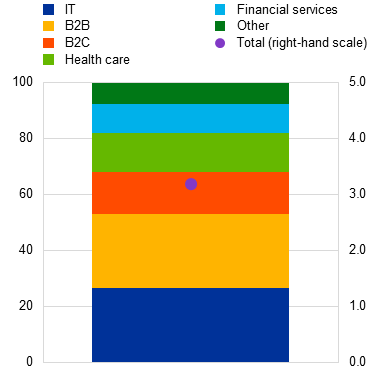 |
Sources: ECB (AnaCredit), Moody’s, PitchBook, a Morningstar company, and ECB calculations.
Notes: Panel a: the interest coverage ratio is defined as EBITDA divided by interest expenses. Firms are included in a funding category when they have outstanding debt of that type (i.e. the funding has been issued by the observation date and has not yet matured). Where maturity dates are missing, they are imputed using the issue date plus the median tenor of the respective funding category. Private credit refers to directly originated, non-syndicated lending − typically involving non-bank institutional investors − including direct lending and mezzanine financing. Leveraged loans are syndicated loans arranged by banks and distributed to institutional investors. High-yield bonds are corporate bonds rated below investment grade. Panel b: B2B refers to business products and services; B2C refers to consumer products and services. Only the “primary industry sector variable” from PitchBook is used. The cited data in both panels have not been reviewed by PitchBook analysts and may be inconsistent with PitchBook methodology.
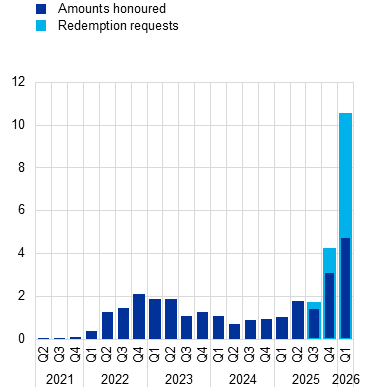
Concerns around credit quality and software-sector exposures have led to a wave of redemption requests from semi-liquid private credit vehicles in the United States. Semi-liquid private credit vehicles such as business development companies (BDCs) have been hit by sizeable redemption requests since the beginning of 2026 (Chart D.2, panel a).[2] While some funds have met investor requests in full, others have capped redemptions at a specific share of fund assets, in line with contractual agreements. These outflows illustrate how a deterioration in risk sentiment can spur investors to withdraw their capital from funds offering redemptions at a regular frequency, despite their portfolio holdings being less liquid. In addition, the outflows have triggered doubts among investors about the future growth of private credit markets, which is reflected in a decline in the stock prices of listed private market firms (Chart D.2, panel b). These companies’ income depends on fund management fees, which are directly linked to private credit fund assets.
Chart D.2
Sizeable redemption requests from US private credit funds weigh on equity valuations of listed private market firms
a) Redemption requests from BDCs in the United States |
b) Stock prices of private market firms and BDCs |
|---|---|
(Q2 2021-Q1 2026, percentages of net asset value) |
(2 Jan.-19 May 2026, index: 2 Jan. 2026 = 100) |
 |
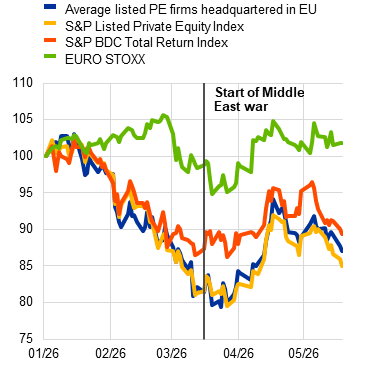 |
Sources: Company SEC filings, Bloomberg Finance L.P. and ECB calculations.
Notes: Panel a: data for a total of 26 non-traded BDCs that reported redemption requests in the periods shown. Panel b: “Start of Middle East war” refers to 28 February 2026. Listed private equity firms headquartered in the EU include EQT (Sweden), CVC (Luxembourg), Eurazeo (France), Antin Infrastructure Partners (France) and Sofina (Belgium).
The rest of this special feature is organised as follows. First, it gives an overview of risks posed by private credit. It then goes on to discuss direct exposures of euro area financial institutions and the potential losses from a simulated shock stemming from private credit. The conclusion comprises an outlook and policy considerations.
2 Sources of financial stability risk posed by private credit
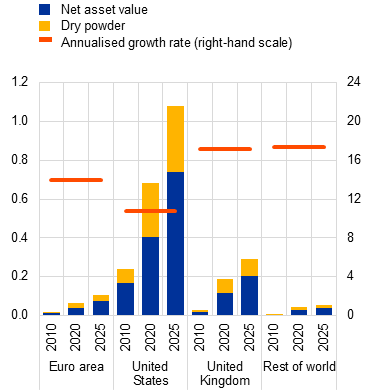
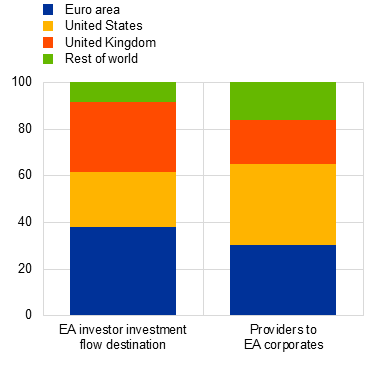
Private credit markets in the euro area are still smaller than they are in the United States but have grown strongly in recent years. In this special feature, private credit generally refers to directly originated, non-syndicated lending by non-bank financial entities to non-financial corporations. Where data limitations require private credit fund data to be used, this narrower scope is stated explicitly.[3] A significant share of private credit is extended to finance company acquisitions made by private equity firms. This means that developments in private credit and private equity are highly interconnected. Estimates of the size of euro area private credit vary, depending on whether the measure captures the location of fund management teams, the legal domicile of the fund, or the location of investors or borrowers. On a management-location basis, the assets under management (AuM) of private credit funds managed from euro area headquarters amounted to roughly €100 billion in 2025 (Chart D.3, panel a).[4] The AuM of private credit funds in the euro area have seen significant growth (an average of 14% per annum since 2010) but remain small compared with domestic public bond markets and bank lending, and with private credit markets in the United States. There are significant cross-border links, as euro area investors allocate around 60% of their private credit investments to foreign funds and euro area non-financial firms receive around 70% of private credit funding from non-euro area funds (Chart D.3, panel b).
Chart D.3
Private credit is small in the euro area and most investment flows and firm credit are to/from abroad
a) Private credit funds’ AuM, by fund location |
b) Destination of flows from euro area investors to private credit funds, and the origin of the providers of private credit to euro area corporates |
|---|---|
(2010-25; € trillions, percentages) |
(2017-26, percentages) |
 |
 |
Sources: PitchBook, a Morningstar company, and ECB calculations.
Notes: Panel a: bars show institutional funds’ AuM, broken down by fund location. The red line shows the compound annual growth rate between Q4 2010 and Q3 2025. 2025 refers to Q3 2025. Fund location is defined as where the fund management team is based. Panel b: EA stands for euro area. Investment flow destination is based on commitments by euro area-located limited partners to private credit funds, classified by the region where the funds are located. Private credit providers’ regional origin is classified using the location of lenders associated with each debt instrument. Regional categories are not mutually exclusive, as individual debt instruments may involve lenders from several regions. Shares are calculated relative to the sum of regional provider debt amounts and normalised to add up to 100%. The cited data have not been reviewed by PitchBook analysts and may be inconsistent with PitchBook methodology.
Risks in private credit funds stem from credit risk, valuation uncertainty, leverage, funding risk and liquidity mismatches.[5] Private credit loans are typically provided to unrated mid-sized companies at floating interest rates and involve lower reporting requirements than public corporate bonds or syndicated loans. Although the benefit of this is faster and more flexible funding, it also creates several risks. First, credit risk is significant, as private credit borrowers tend to have weaker credit quality as measured by interest coverage ratios (Chart D.1, panel a). Second, there is significant asset valuation uncertainty, as the loans are largely illiquid, meaning that valuations rely on subjective model assumptions. Third, while leverage in private credit funds is relatively low on average, it comes on top of leverage at the firm or investor level, thus accumulating total leverage along the intermediation chain.[6] Fourth, funding risk appears contained at present, as banks continue to lend to private credit funds, and funds’ dry powder − committed but not yet invested capital − remains sizeable, although this assessment could change if bank financing or fundraising conditions deteriorated.[7] While high amounts of dry powder can provide a cushion against a slowdown in freshly committed capital, they could also incentivise fund managers to weaken underwriting standards as they attempt to deploy capital despite diminishing investment opportunities. Fifth, liquidity mismatch in private credit funds appears limited in traditional closed-ended private credit funds, which do not offer regular redemptions between launch and closure. However, it could grow as new partly retail-oriented semi-open private credit vehicles − offering regular redemptions at a specified frequency − expand.
3 Direct exposures of euro area financial institutions to private credit
Non-banks are typical investors in private credit markets, whereas banks are the main lenders to the private credit ecosystem as a whole. For clarity, direct exposures as understood here means holdings of private credit fund shares, lending to private credit funds or, in the case of insurance corporations, direct lending to non-financial firms. Indirect exposures through leveraged loans, high-yield bonds or equities are considered separately below. Large institutional investors like insurance corporations and pension funds are major investors in private credit funds − the main conduits through which private credit is intermediated.[8] The same investors may also be exposed to the public debt of the same or similar borrowers, creating a potential contagion channel across asset classes. Banks interact with the private credit ecosystem by lending to three different sets of players: (i) private credit investors, (ii) private credit funds, and (iii) portfolio companies (directly). This provision of leverage creates several channels through which stress in private credit markets could be transmitted to the banking sector.[9]
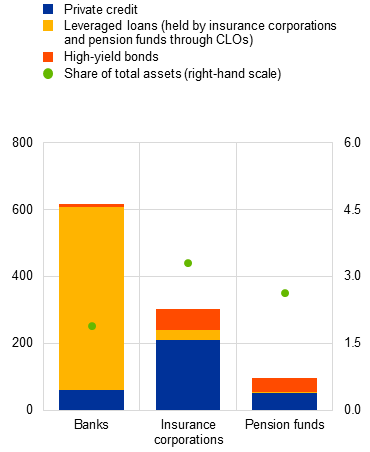
Euro area banks, insurance corporations and pension funds appear to have limited exposures to private credit in aggregate, but the exposures are concentrated in a few large players. Of these entities, insurance corporations are the most exposed to private credit (Chart D.4, panel a). The private credit exposures of insurance corporations and pension funds are estimated at roughly €211 billion and €52 billion respectively, or around 2.3% and 1.4% of total assets, with considerable heterogeneity across countries and significantly higher exposures in Germany, France and Netherlands.[10] In the United States, private equity firms have increasingly been acquiring life insurers, resulting in an increase in such insurers’ holdings of private market assets.[11] In the euro area, this activity appears to be more limited, despite showing an upward trend.[12] ECB supervisory data estimate that euro area banks’ exposures to private credit worldwide total €62.5 billion, which is 0.2% of total assets or 2.5% of total equity.[13] In the case of both banks and insurance corporations, exposures are, however, highly concentrated in a small number of large institutions.
4 Scenario analysis of a simulated shock to global private credit and a comparison with the US subprime mortgage market in 2006
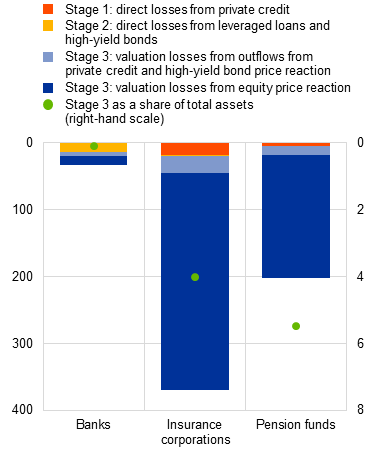
A simulated severe shock to global private credit markets suggests that direct losses would be limited for euro area institutions, but broader spillovers could be larger. The scenario simulates a sharp increase in defaults on loans originated in private credit markets across sectors, together with a particularly severe shock to the software sector (Chart D.4, panel b). Such a shock could interact with potentially higher borrowing costs for firms, given current geopolitical uncertainties around oil prices and the path of future interest rates. To isolate different channels, the illustrative exercise presents three stages: (i) direct private credit losses, (ii) additional losses from loans to software firms in correlated leveraged debt markets, and (iii) broader second-round market revaluations. First, private credit losses are considered in isolation, as depicted by the red bars in the chart. Then defaults in the software sector in high-yield bonds and leveraged loans are added due to their comparable risk profile (yellow bars). The final stage is adverse second-round valuation effects in public markets (blue bars). As a tail-risk assumption, these valuation effects reflect strong declines in high-yield bond prices and in the prices of traded private credit funds. The declines stem from outflows from high-yield bond funds and semi-open private credit vehicles, together with falling equity markets after a reversal in sentiment.
While the direct impact on banks is small, it is larger for insurance corporations and pension funds. Banks’ losses from private credit remain contained in all three stages – not exceeding 1.3% of total equity – due to the seniority of banks’ loans to private credit funds and the relatively small size of their exposures. While banks’ exposures to leveraged loans are high, losses from associated exposures to the software sector or from broader market revaluations remain small in aggregate. Insurance corporations face the largest impact in absolute terms, stemming from their larger and less senior exposures to private credit and, when considering broader market revaluations, from their equity holdings in particular.[14] Pension funds are the most heavily affected by aggregate losses from all three stages in terms of total assets. This is largely driven by their equity holdings when broader market revaluations are taken into consideration. In summary, in this exercise by far the largest impact comes from the third stage: the assumed second-round valuation losses.[15] Under the assumptions used, direct losses from a shock to private credit loan portfolios appear manageable, while adverse market reactions in response to the shock could create sizeable valuation losses. Insurance corporations and pension funds are generally well positioned to weather such valuation losses because they have long investment horizons and hold liabilities that are not subject to immediate run risk.
Chart D.4
Exposures to private credit and leveraged debt markets are limited in aggregate, but a shock to private credit markets could spill over and cause wider valuation losses
a) Direct exposures of euro area entities to private credit and leveraged debt markets |
b) Simulated losses for euro area financial entities from broad defaults in private credit and a severe shock in the software sector |
|---|---|
(2025; € billions, percentages of total assets) |
(2025; € billions, percentages of total assets) |
 |
 |
Sources: ECB (ICB, PFBR, SHS, supervisory data), EIOPA and ECB calculations.
Notes: Panel a: banks’ private credit is based on ECB supervisory data, as published in the Financial Stability Board’s Report on vulnerabilities in private credit, estimating 12 euro area banks’ private credit fund exposures as of 2024, considering only drawn amounts. Banks’ leveraged loan exposures (including holdings of non-investment-grade collateralised loan obligations (CLOs)) are based on unpublished supervisory data surveying 47 banks as of Q4 2025. High-yield bond holdings are based on securities holdings statistics for Q4 2025, covering tradable corporate bonds rated lower than BBB, where the rating is defined as the worse of the instrument-level and issuer-level ratings. The private credit exposures of insurance corporations and pension funds are based on EIOPA’s December 2025 Financial Stability Report. Real estate-related exposures (including mortgages), policy loans and collateralised securities are excluded. Private credit is proxied by non-listed corporate debt, loans and selected structured credit instruments (including look-through data), adjusted for intragroup holdings. Insurance corporations’ and pension funds’ CLOs are shown under “leveraged loans”. These exposures are based on EIOPA data reporting “collateralised securities – credit risk” and are assumed to be CLOs holding leveraged loans. Unlike for banks, a split by rating is not available. Q4 2024 exposures are projected to Q2 2025 using reported growth rates and asset changes. ECB and EIOPA data follow different methodological and reporting frameworks, which may lead to differences in aggregates such as total assets and in the entities covered. Panel b: the scenario simulates a sharp increase in defaults across sectors in global private credit markets and a particularly severe shock in the software sector. In stage 1, private credit in isolation is shocked; in stage 2, software loans in leveraged loans and high-yield bonds are shocked; finally, in stage 3, an adverse market reaction to the initial shock in private credit is simulated by a 30% decline in equity prices plus strong outflows from high-yield bond funds and open-ended private credit funds, leading to a change of 25% in the valuation of high-yield bonds. Default rates of 10% at 50% loss given default (LGD) are applied to general direct exposures to private credit, and of 30% at 80% LGD to software exposures in private credit, leveraged loans and high-yield bonds. The seniority of bank lending to private credit funds is taken into account, and equity losses for banks are calculated according to the 2025 bank stress test market risk methodology published by the European Banking Authority, adjusted to match the equity market shock size in this analysis. Equity exposures of insurance corporations may include listed shares of subsidiaries and participations and are thus upper-bound estimates. Insurance corporations’ and pension funds’ listed equity and high-yield bond exposures held through investment funds are accounted for by combining the sectors’ fund holdings with funds’ exposures to listed equities and high-yield bonds, based on the method set out in Baudino et al.*
*) See Baudino, P.A., Metzler, J., Storz, M. and Wagner, F., “The role of household investors in market downturns”, Financial Stability Review, ECB, November 2025.
Private credit differs from the pre-crisis US subprime mortgage market, but its possible role in AI-related funding should be closely monitored. The US private credit market totalled around USD 1.4 trillion as at the end of 2024, representing 4.7% of US GDP. In nominal terms, this is roughly equal in size to the pre-crisis subprime mortgage segment of USD 1.5 trillion in 2006. The latter, however, represented nearly twice as big a share of the economy as a whole, accounting for 10.9% of GDP. Unlike subprime lending, leverage in private credit is low, and most funding is long term and not subject to run risk. Euro area bank exposures to private credit are currently also significantly smaller than their exposures to US subprime markets have been in the past and involve mostly senior lending. This means that the euro area banking sector is unlikely to suffer material losses from its private credit exposure, also because banks currently have higher levels of regulatory capital and ample liquidity buffers. Private credit could, however, become an important source of funding for AI data centres and AI-related firms.[16] In this case, private credit markets – and hence euro area exposures – could quickly grow much larger. At the same time, expected productivity gains and future earnings from AI investments remain highly uncertain and could disappoint. If exposures grew rapidly and expected AI-related cash flows disappointed, private credit could become a more material source of credit risk and a potential amplifier of stress for euro area financial institutions.
5 Outlook and policy considerations
Private credit in isolation is unlikely to threaten financial stability in the euro area at present, but data gaps hinder a full risk assessment, and its opacity, its concentration and the potential for spillovers remain concerns. A sudden reversal in market sentiment could see financial stress spill over to broader markets and cause sizeable valuation losses. This could be reinforced by the opacity of private credit markets and investors could react strongly. Uncertainty about the size and concentration of exposures at the institution level, coupled with incomplete information about the underlying credit quality, could weigh on risk sentiment. This might also have an impact on asset classes outside private credit markets. Private credit may be more exposed to downturns in riskier companies and to sector-specific shocks, including AI-related disruption in software and disappointment around the returns on AI investment. The growth of private markets and interconnections with traditional financial entities need to be monitored continuously, as financial stability risks might increase. A watchful eye should also be kept on the expansion of private markets into retail-oriented structures, as these could be associated with higher liquidity mismatches.
Private credit markets can help to advance the EU’s savings and investments union (SIU) agenda. By matching the financing needs of riskier firms with the risk-bearing capacity of long-term investors, private markets perform an important intermediation function. Together with private equity, they channel funding to productive and innovative firms.[17] They may thereby facilitate the development and adoption of new technologies, diversify the financing of euro area corporates and support economic growth, in line with the SIU agenda.[18] To realise these benefits, however, risks and vulnerabilities in private markets will need to be contained, particularly in the private fund sector. A balanced approach would combine progress on the SIU agenda with safeguards that preserve investor confidence and contain vulnerabilities in deeper capital markets.
Risks related to opacity and liquidity mismatches need to be addressed to ensure that private credit remains a stable and reliable source of funding. Addressing data gaps in private credit is essential for effective risk assessment by authorities and sound risk management by market participants.[19] This requires enhanced data collection and improved sharing of existing data across the EU. Given the strong cross-border dimension of private credit, further efforts are needed at the global level to develop consistent definitions and taxonomies that enhance cross-jurisdictional comparability and to close data gaps based on these defined taxonomies. In addition, it would be useful to assess the extent to which existing recommendations by the Financial Stability Board, such as those on liquidity mismatches in open-ended funds and leverage in the non-bank financial intermediation sector, apply to private credit funds, as previous work has not focused on this segment. At the EU level, several frameworks apply to private credit funds, including leverage limits for loan origination funds under the Alternative Investment Fund Managers Directive (AIFMD)[20] and liquidity rules under the European Long-Term Investment Funds (ELTIF) Regulation.[21] However, not all private credit activities are captured by these frameworks, and additional safeguards may be needed where material financial-stability or investor-protection gaps are identified. Moreover, supervisors should continue, within existing mandates and frameworks, to identify risks from private credit and support investor confidence in private markets. For example, the recent revision of Solvency II strengthens the framework for insurance corporations by enabling supervisors to incorporate macroeconomic and macroprudential considerations into risk assessments.[22] From a banking supervision perspective, this includes following up on supervisory expectations, continuing data collection efforts and closely monitoring the most exposed institutions.[23]
Legal Disclaimer:
EIN Presswire provides this news content "as is" without warranty of any kind. We do not accept any responsibility or liability for the accuracy, content, images, videos, licenses, completeness, legality, or reliability of the information contained in this article. If you have any complaints or copyright issues related to this article, kindly contact the author above.
